Hold On! – Since when is parking a generic domain bad faith?
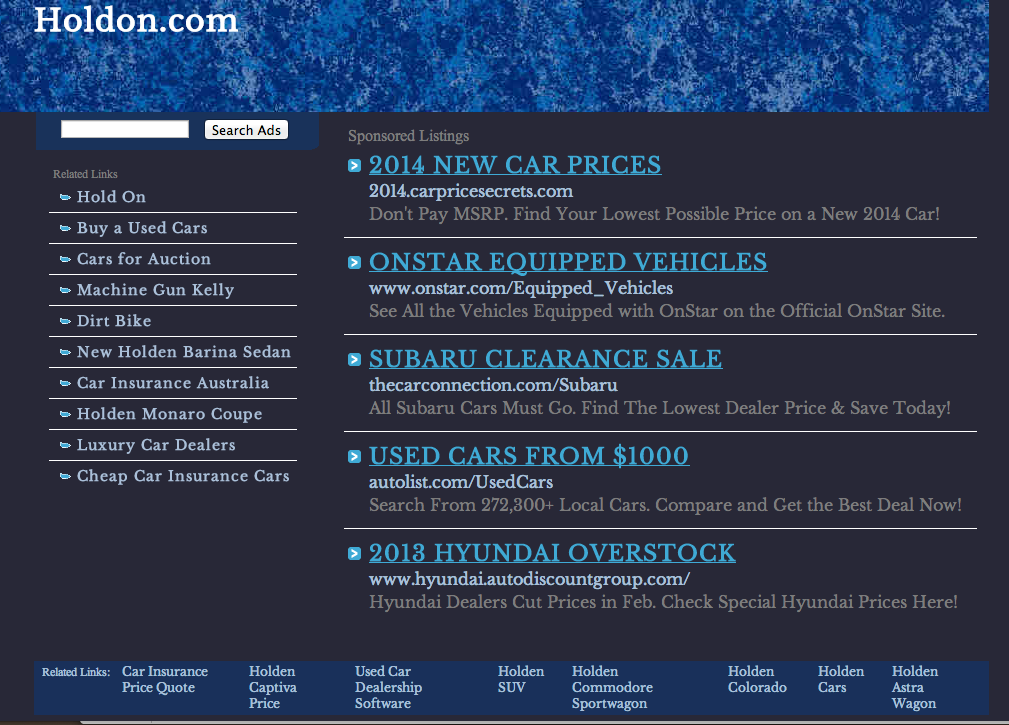
In the recent HoldOn.com decision, sole panelist Christopher Pibus found the domain owner guilty of bad faith for simply placing the domain on a parking page. Pibus made the bad faith finding despite there being no evidence that any of the ads on the parked page were infringing. When I visited the page at HoldOn.com, the ads were related to cars (screenshot below). Swedish company Amicus Trade AB, the Complainant, has a trademark on ‘holdon’ for clips.
Pibus found bad faith because that the seventeen year-old holdon.com domain was interfering with the Complainant’s business-
The Panel is further prepared to accept the Complainant’s uncontested assertions that the use of the disputed domain name in association with a click-through site has interfered and/or is interfering with the Complainant’s business, and that the disputed domain name is leading Internet customers seeking the Complainant’s website to the Respondent’s unauthorized website for purposes of monetary gain. In the absence of any evidence to the contrary, the Panel finds that the disputed domain name was registered and used in bad faith by the Respondent.
I fail to see how using, in a non-infringing way, a generic domain that long predates the existence of the Complainant is interfering with the Complainant’s business. If merely using the holdon.com is interfering with Amicus Trade’s business, then the domain began interfering with the Complainant’s business the moment that Amicus Trade starting making use of the ‘holdon’ brand fifteen years ago. Yet as the domain predates the business, it makes no sense to accuse the domain of interfering with the business. Why is the current use bad faith when the previous uses of the holdon.com domain were not? Are owners of generic domains not allowed to place ads on their websites that don’t infringe on any other trademarks? Is it bad faith to try to make money from your website when you aren’t infringing on anyone else’s trademark rights?
The domain owner failed to file a response. Even so, in order to succeed in a UDRP the Complainant must demonstrate that the registration and use is in bad faith.
Pibus’ position that placing non-infringing ads on a non-distinctive domain is bad faith use targeting the trademark holder is an overreach. It expands the rights of trademark holders far beyond any legal foundation. This approach also has the practical effect of putting every parked non-distinctive domain at risk, if the domain is at all similar to an existing trademark.
The HoldOn.com decision, and other similar decisions such as the MyArt.com decision and the Ovation.com decision, pervert the intention of the UDRP. In these cases the UDRP is not, as it is supposed to be, a procedure for protecting trademark holders from blatant cybersquatters. Instead, in these cases the UDRP is a tool whose purpose is to steal from their owners valuable non-distinctive domains that are coveted by the trademark holders but to which the trademark holders have no legal right.